Atinamos Agent
The live machine-facing service shop, including Render Check, Buyer Check and deterministic JSON validation and repair for AI agents.
Atinamos built and tested a live service that autonomous agents can discover, evaluate, pay for and use. The experiment asked a practical question: can software complete a genuine commercial journey without a person guiding each step?
For an AI agent to become a customer, finding a web page is not enough. It must discover a suitable service, understand it, compare alternatives, accept the price and terms, submit valid work, pay, and retrieve a useful result.
We explored whether that whole chain could work in practice—not as a staged conversation, but through live infrastructure and machine-readable contracts.
The route was not linear. Each environment helped clarify what autonomous commerce needs, even when it did not produce genuine demand.
Some routes were technically interesting but did not create autonomous commercial demand. That was useful evidence too: infrastructure and agent activity do not automatically create customers.
$0.25 USDC per check
A specialist verification service for finished public websites. It loads a submitted site in real desktop and mobile Chromium, then returns evidence another system can inspect.
Desktop and mobile Chromium sessions test what a visitor’s browser actually receives and renders.
HTTP and browser failures, failed requests, console errors and warnings are recorded.
Desktop and mobile screenshots provide direct evidence of the completed render.
Result JSON and SHA-256 verification hashes make the output usable by other systems.

An agent supplies a public finished website URL.
The gateway accepts the paid request and creates an asynchronous job.
The worker runs desktop and mobile browser checks and collects evidence.
The agent follows the status URL to the machine-readable result and screenshots.

We used an independent buyer running on AWS Bedrock AgentCore with Claude as a neutral test harness. It searched the complete x402 marketplace, evaluated the available audit services and selected the offer it considered most suitable.
At first, it often chose competitors. The service itself was working, but its Bazaar listing did not explain the specialist capability, output or buying process clearly enough for a machine to distinguish it from cheaper, broader audits.
The uncomfortable result
Human readers could infer why real desktop and mobile browser verification mattered. The buyer should not have needed to infer it.
Atinamos proposes the term “Machine Contract Optimisation (MCO)” for the practice of structuring a machine-buyable service’s identity, capabilities, pricing, inputs, outputs, examples, trust signals and execution terms so autonomous agents can accurately discover, evaluate, select and invoke it.
SEO helps people and search engines find a service. MCO helps autonomous agents decide whether to trust, buy and use it.
We use MCO as a proposed description arising from this experiment, not as an established industry standard. For Render Check, the practical work included improving the service name, tags, capability description, output contract, absolute status URL and result metadata. Read the full explanation of Machine Contract Optimisation.
Before
Unclear machine contract
Buyer chose a competitor
After
Clearer machine contract
Same neutral buyer ranked Atinamos #1
We reran the neutral buyer test without instructing it to favour Atinamos. After the metadata refresh, it ranked Atinamos Render Check first for independent pre-handover website verification. It distinguished real-browser desktop/mobile verification from lower-cost static audits and judged the $0.25 price justified for that capability.
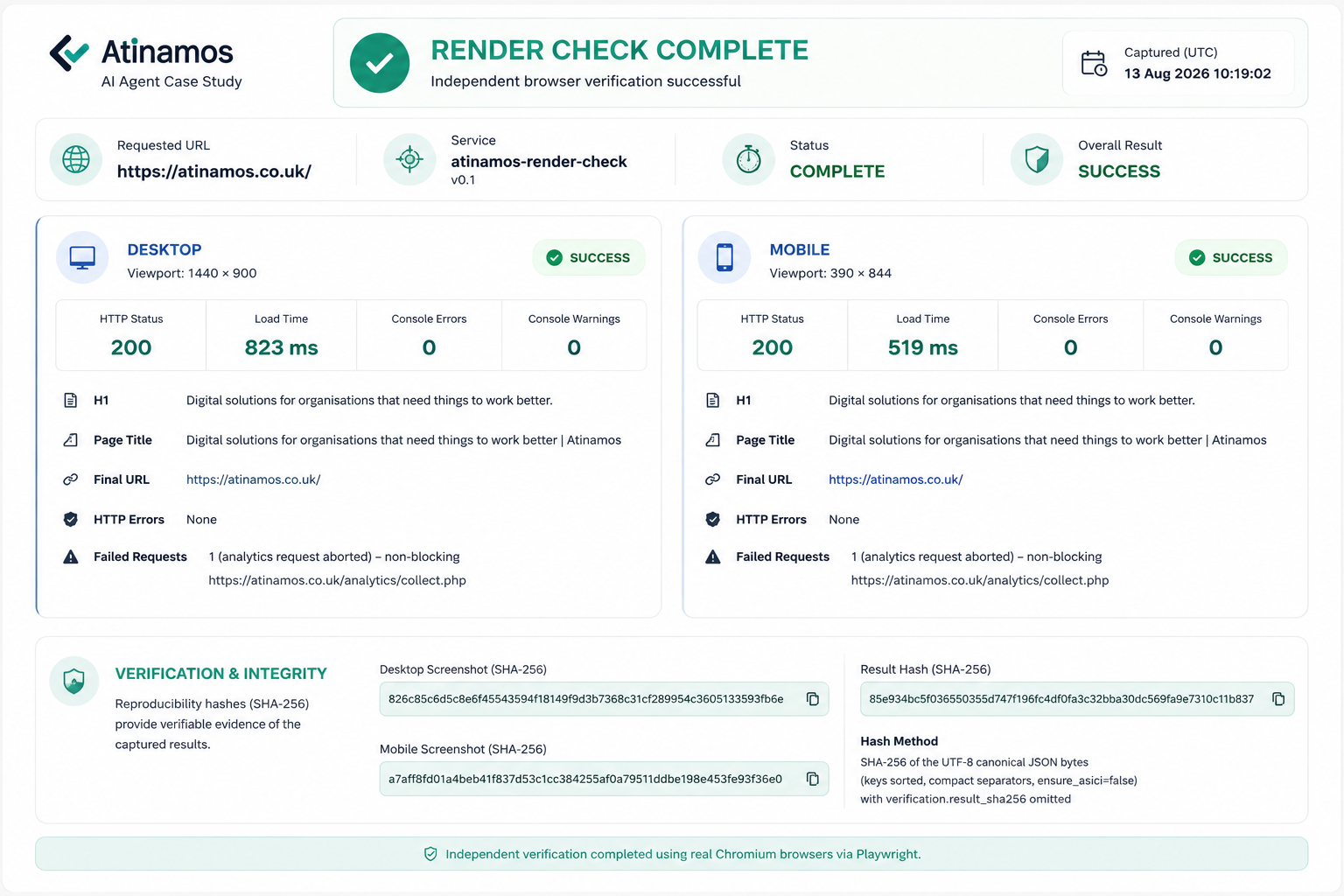
The technical path is working: Render Check is live, paid x402 settlement has completed, Bazaar can surface the service, and an independent buyer can evaluate it accurately. The next stage is harder and more commercially meaningful—observing whether unrelated agents choose and pay for it organically over time.
The commercial experiment now has two distinct public homes: one for live machine-facing services and one for independent research and evidence.
The live machine-facing service shop, including Render Check, Buyer Check and deterministic JSON validation and repair for AI agents.
The independent research and evidence project for autonomous commerce, with paid-service studies and machine-readable observations. It publishes evidence for buyers to assess rather than a universal trust verdict.
We can help examine the service, its machine-facing contract and the evidence an independent buyer needs to make a sound decision.