Turning a language-learning problem into a practical digital product
Spanish Unstuck began while the people behind Atinamos were learning Spanish themselves. They recognised a common problem: it was possible to understand and recognise Spanish during lessons or practice, but much harder to recall and say the same language independently.
What began as a development experiment became an active-recall practice app designed to help people retrieve Spanish they have already learned elsewhere.
Problem: Recognising Spanish is not the same as being able to recall it
Many digital tools and resources help learners recognise the correct answer through multiple-choice questions, visual prompts, or immediate translations. While helpful for starting out, this recognition practice creates a gap where learners understand Spanish when it is shown to them, but struggle to produce it independently in a conversation.
The challenge was not simply learning more vocabulary. It was creating a way for learners to practise retrieving words and phrases independently — closer to what happens during a real conversation.
Spanish Unstuck was built to complement existing resources. It acts as a recall-practice tool and companion for practising Spanish already learned elsewhere, working alongside private tutors, courses, reading, conversation practice, and other language-learning apps.
The Idea: Building the missing recall step
Atinamos explored a practice structure designed around active recall, prompting the user to retrieve language from memory rather than selecting it from a list. The core workflow encourages the learner to:
- Read or understand the English prompt.
- Attempt to recall the Spanish equivalent independently from memory.
- Reveal or receive support only when needed.
- Say the retrieved answer aloud to reinforce active recall.
- Repeat and strengthen retrieval over time.
To support users when they become stuck, we introduced an optional Guided Recall method using a three-stage structure: Show, Try, and Say. This provides temporary clues (such as revealing letters or grammatical markers) to help the user work towards retrieval, encouraging them to attempt and say the Spanish themselves without immediately giving away the full answer. Guided Recall is designed to support the user through difficult recalls rather than teaching new grammar or vocabulary.
What Atinamos delivered
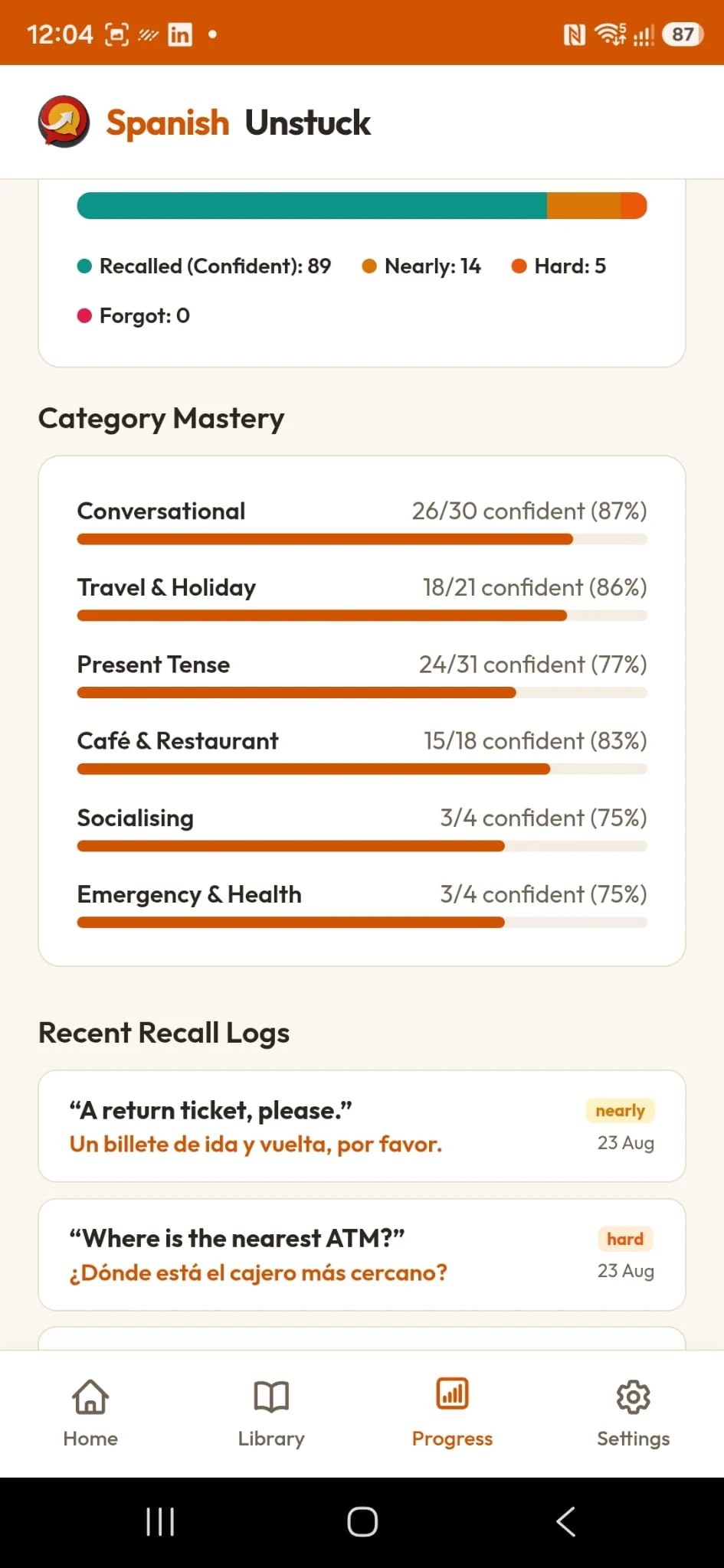
We developed a complete mobile-first web application designed around active-recall practice flows:
Product concept and learning approach
Atinamos defined the core active-recall approach, practice flow and supporting features around the real experience of learning Spanish.
Mobile-first web application
A responsive web app designed to work comfortably on mobile phones, tablets and desktop screens.
Structured practice levels
Practice content organised across A1, A2 and B1 levels so learners can work with material appropriate to their current stage.
Active-recall practice sessions
Sessions encourage learners to attempt the Spanish answer before revealing it, helping shift practice away from recognition alone.
Guided Recall
A three-stage support method — Show, Try and Say — that helps learners work towards independent recall when they become stuck.
User accounts and progress
Account and progress features allow learners to return to the app and continue their practice over time.
Access and Stripe payment integration
A structured access system and Stripe payment integration were developed to support free and enhanced access, with payments handled through Stripe's established payment platform.
Progressive Web App support
The product was built as a mobile-friendly Progressive Web App, allowing it to behave more like an installed app on supported devices.
Content and administration tools
Practical systems were developed to manage phrases, levels, access and product content as the app continues to grow.
Analytics and product improvement
Privacy-conscious analytics help Atinamos understand general product usage and identify areas that may need improvement.
Search and discovery content
Supporting pages were created around common learner difficulties, including speaking confidence, active recall, learning plateaus and the experience of understanding Spanish but struggling to speak it.
Ongoing iteration
Spanish Unstuck continues to evolve as the learning flow, content and supporting features are reviewed and improved.
Development Approach: From experiment to working product
Developing Spanish Unstuck involved more than building individual pages. It was an end-to-end product development exercise that required:
- Identifying the core learning problem and target user friction.
- Designing the active-recall practice method and interface.
- Structuring the phrase database, sorting rules, and metadata.
- Developing a simple and intuitive user account registration flow.
- Creating account access controls and Stripe payment integrations using Stripe's established payment platform.
- Building mobile-friendly touch interactions and progress saving.
- Testing the practice sessions with real Spanish learners to refine the flow.
- Creating targeted, content-led landing pages and privacy-conscious analytics.
Because Atinamos owns and operates the product, development can continue in response to practical learning observations rather than ending at the initial launch.
Outcome: A complete product built around a focused idea
Spanish Unstuck developed from a small experiment into a complete active-recall learning product. It demonstrates how Atinamos can identify a practical problem, shape the idea, develop the underlying system and continue improving the product after launch.
Have an idea that could become a practical digital product?
You do not need to arrive with a technical specification. Tell us about the problem, the people it affects and what you would like to make easier.